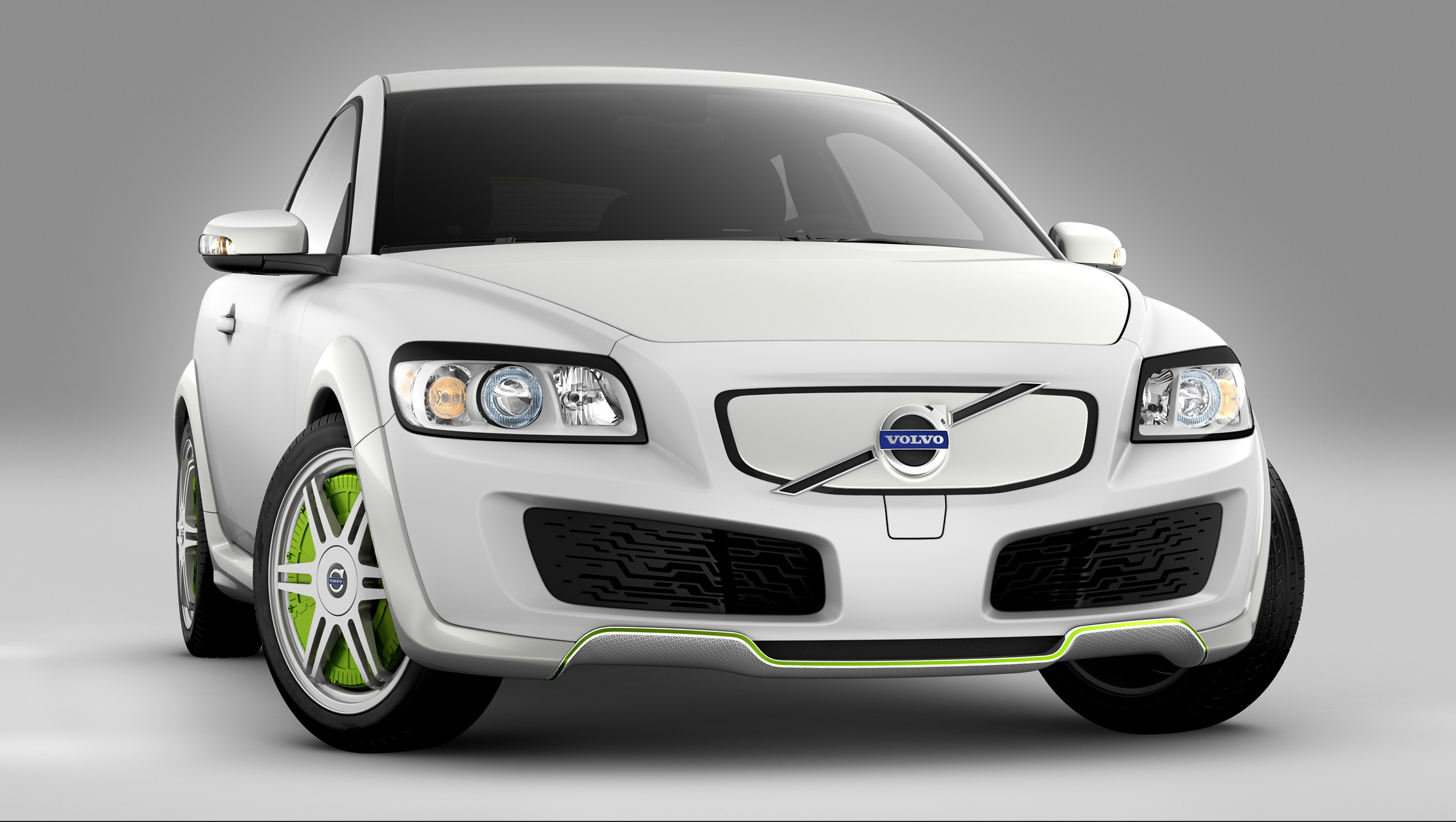
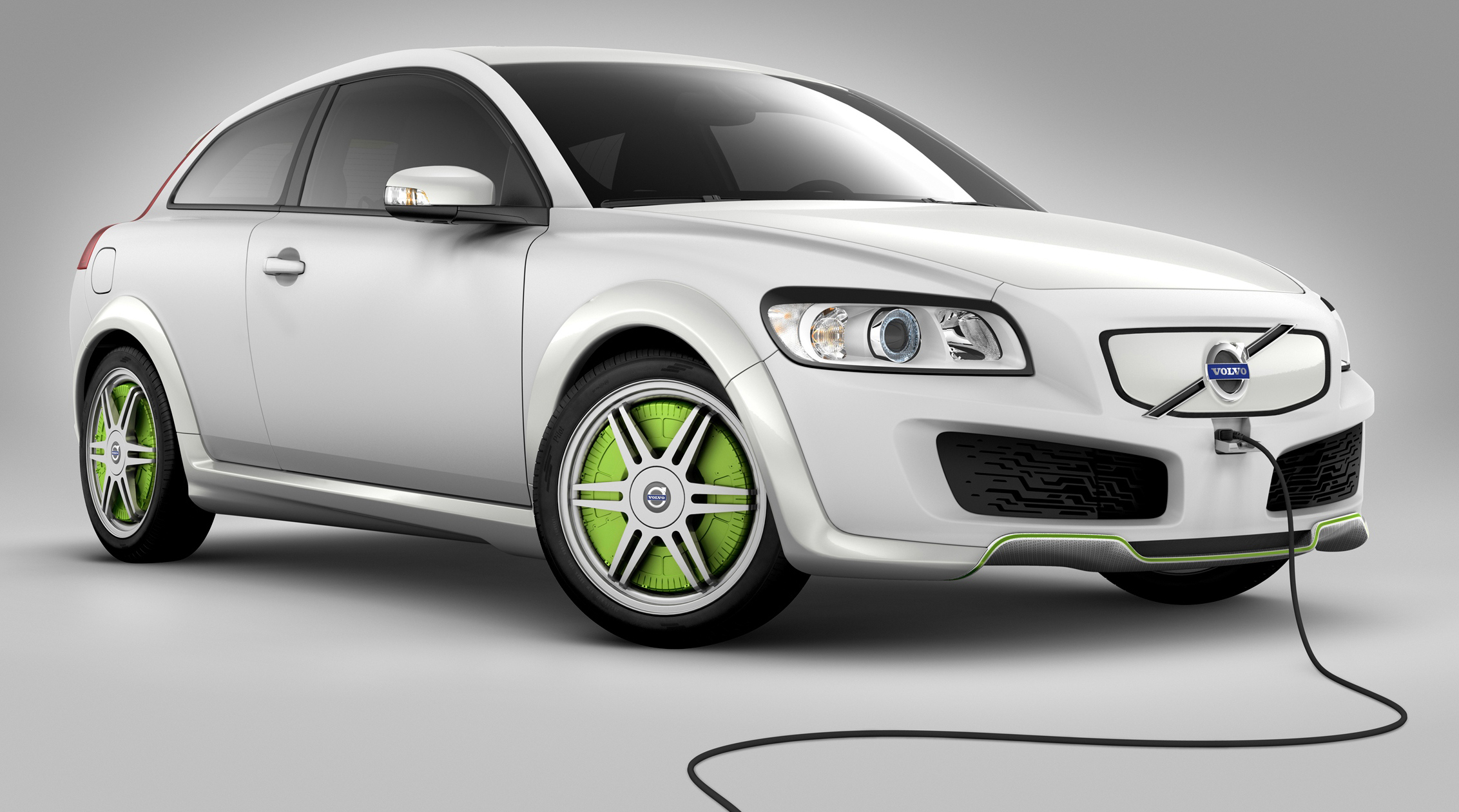
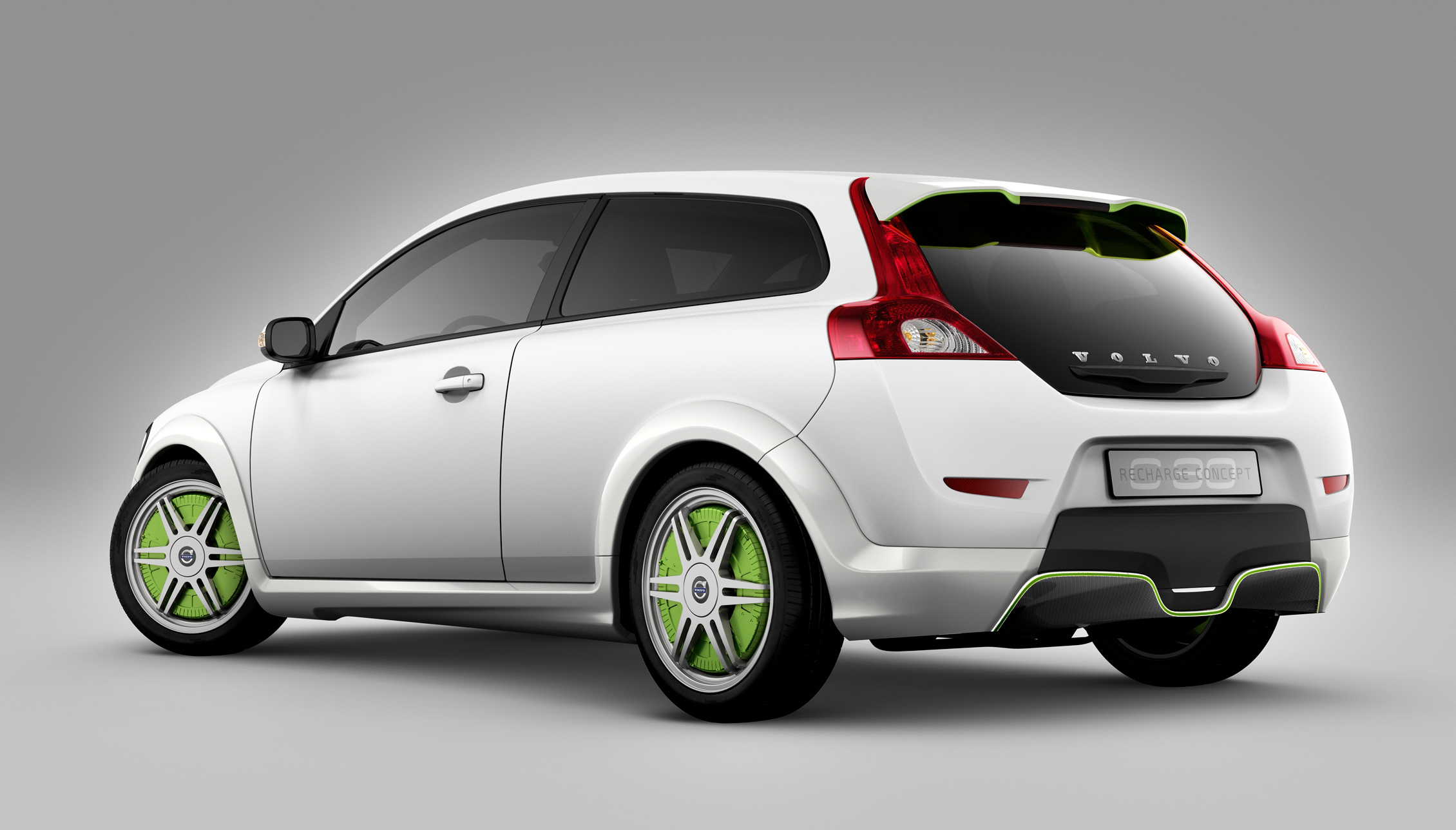
 The Volvo ReCharge Concept on display at the Paris Motor Show is a groundbreaking plug-in hybrid. The specially designed Volvo C30 features individual electric wheel motors and batteries that can be charged via a regular electrical outlet. When fully charged the Volvo ReCharge Concept can be driven approximately 62 miles on battery power alone before the car’s four-cylinder combustion engine is needed to power the car and recharge the battery. The concept car also retains the Volvo C30’s lively and sporty drive thanks to an acceleration figure of 0-62mph in 9 seconds and a top speed of 100mph.
“This is a groundbreaking innovation for sustainable transportation. This plug-in hybrid car, when used as intended, should have about 66 percent lower emissions of carbon dioxide compared with the best hybrid cars available on the market today. Emissions may be even lower if most of the electricity comes from CO2-friendly sources such as biogas, hydropower and nuclear power. A person driving less than 60 miles per day will rarely need to visit a filling station. Also, thanks to the excellent electrical range from a fuel consumption angle, the Volvo ReCharge Concept is exceptionally kind to the car owner’s wallet,” commented Magnus Jonsson, Senior Vice President Research & Development at Volvo Cars.
Operating costs are estimated to be about 80 percent lower compared to a similar petrol-powered car. The Volvo ReCharge Concept is best suited for car drivers who cover short distances every day. For example, a car owner with less than 62 miles to drive between home and work can cover the entire distance on electric power alone. Even someone who covers longer distances than the range afforded by the batteries can count on significant environmental benefits. A trip of 93 miles that starts with a fully charged battery should use less than 2.8 litres of fuel.
The only extra cost will be the electricity used during charging. The Volvo ReCharge Concept can be charged at any regular electric plug socket at convenient locations such as at home or work and a full recharge will take three hours. However, even a quick one hour charge provides enough power to cover just over 30 miles.
During a journey the combustion engine starts up automatically when 70 percent of the battery power has been used up. However, the driver also has the option of controlling the four-cylinder combustion engine manually via a button in the control panel. This allows the driver to start the engine earlier in order to maximise battery charge, for instance when out on a motorway in order to save battery capacity for driving through the next town.
“A certain proportion of electric cars will be an integrated part of our future product portfolio. Since the Volvo ReCharge Concept has an excellent operating range on battery power alone while at the same time integrating its own combustion engine for back-up power on the move, this is a highly interesting concept for the future,” says Magnus Jonsson, Senior Vice President Research and Development at Volvo Cars.
An electric motor at each wheel
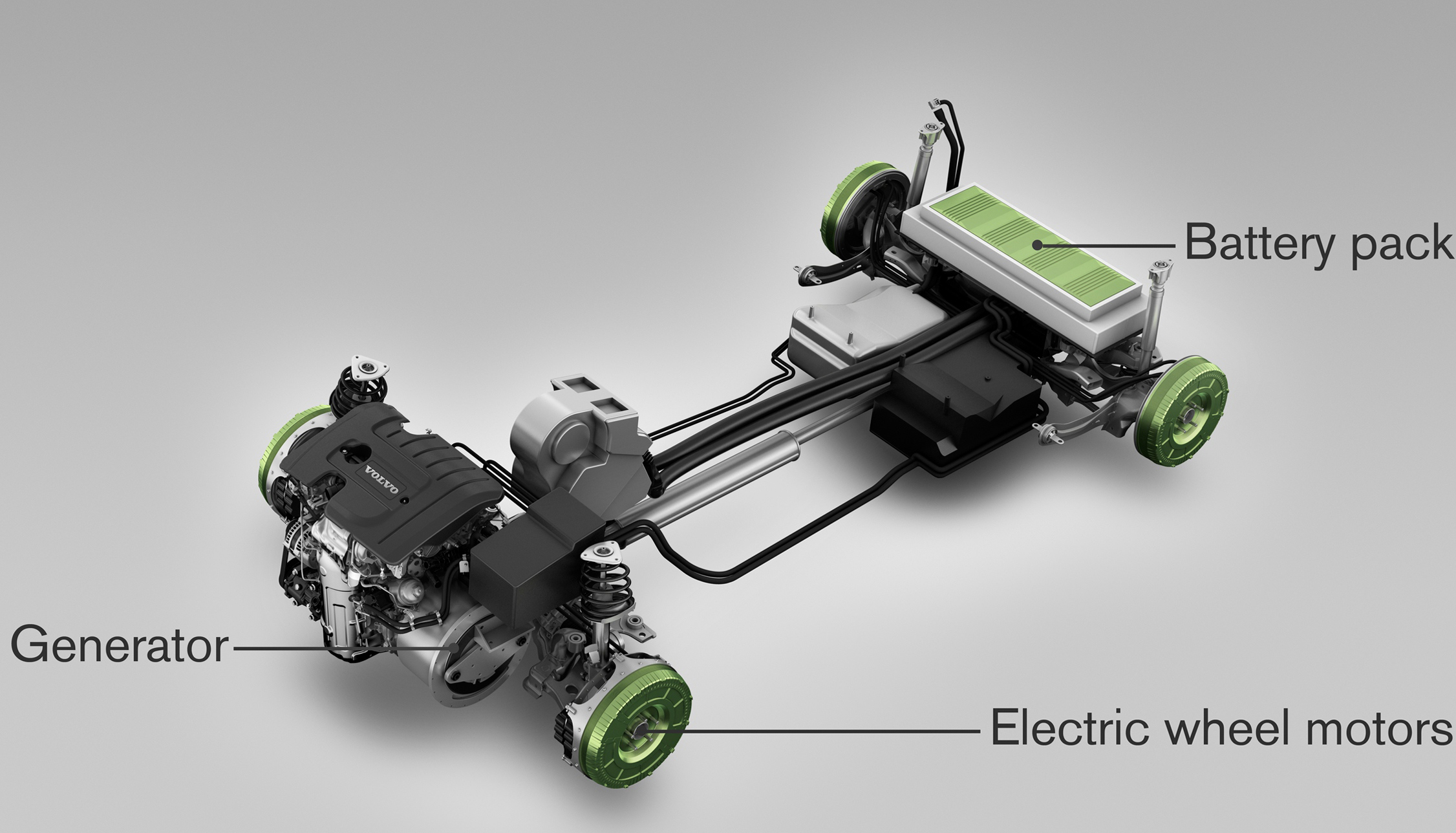
There is no mechanical power transmission from the combustion engine to the wheels. The Volvo ReCharge Concept is what is known as a series hybrid featuring a number of interacting technologies:
- The battery pack installed under the luggage compartment’s floor consists of lithium-ion-polymer batteries. They are designed for a lifetime longer than that of the car itself.
- Four electric motors, one at each wheel, provide individual four-wheel drive.
- A four-cylinder combustion engine drives the advanced generator that provides power for the wheel motors when the battery requires a recharge. Possible engine alternatives are for instance a four-cylinder 1.6-litre diesel or a four-cylinder Flexifuel engine.
“There is a considerable difference between the Volvo plug-in hybrid and today’s hybrids. Today’s hybrids use the battery only for short periods to assist the combustion engine. Volvo’s solution is designed for most people to run on electric power all the time, while providing the extra security that comes with having a combustion engine as a secondary source of electrical power,” says Ichiro Sugioka, project manager for the Volvo ReCharge Concept.
Electric car with a combustion engine as backup
The Volvo ReCharge Concept is a battery electric car with an efficient generator, an Auxiliary Power Unit (APU), that steps in when battery charge becomes insufficient for adequate driving performance. The APU is designed to distribute electrical power to the individual motors at each wheel. Since the combustion engine only powers the APU, it can operate in an optimal fashion, both for regulated emissions and CO2. The APU is powerful enough to supply an entire house with electricity. For example it could, in principle, with minor modifications, give the car owner an electricity generator right at his front door in the event of a power failure.
Specially developed electric motors
The central electrical components in the Volvo ReCharge Concept – the generator for the APU and the wheel motors – were developed together with British electromagnetic specialists PML Flightlink.
With an individual electric motor at each wheel, weight distribution as well as mechanical efficiency and traction are maximised and the friction in mechanical gears is eliminated. Since the car does not have the transmission found in ordinary cars, there is no need for a gear lever.
To help maximise the environmental benefits, the Volvo ReCharge Concept has high-efficiency tyres developed by Michelin which are specially designed to accommodate the wheel motors. The car also has All-Wheel Drive in the truest sense of the term as power to each wheel is controlled individually.
The energy that is generated during braking is transmitted to the battery pack. When the system is ultimately developed, traditional wheel brakes will be completely replaced by electrical brakes with minimal energy wasted through friction. An electronic control system with quadruple redundancy contributes to the driveline’s and braking system’s operating reliability.
 There are plenty of reasons to visit the Volvo stand at the 2008 Cycle Show which takes place at Earls Court between 10-12 October. Volvo will once again co-sponsor the very popular Mountain Bike Test Track and alongside displaying a selection of new Volvo models, there will also be a guest appearance from an Olympic Gold medallist sailor and the chance to win a weekend in the new Volvo XC60.Volvo has a long commitment to designing cars suitable for outdoor hobbies, such as cycling and while the Volvo range has become increasingly stylish, it still remains practical and versatile. On display is a selection of these versatile models including the Volvo XC70 Volvo Ocean Race Edition, the striking C30 R-DESIGN Sport and the new stunning Volvo XC60 crossover. Volvo also has its own range of bicycle holders so bikes can be transported safely and securely, whether they are on the roof of the car, in the boot or attached to a towbar.
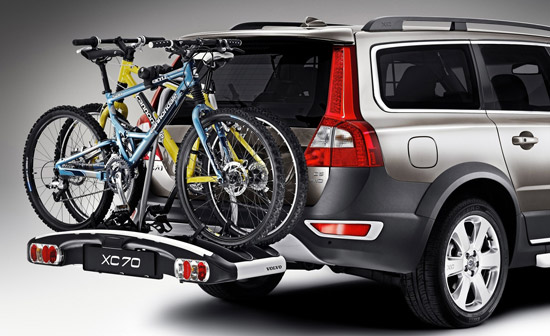
Karen Donovan, Events Executive at Volvo Car UK Ltd, said: “The Volvo range, particularly the new Volvo XC60, is perfectly suited to the demands of an active lifestyle so it’s a great match for visitors to the UK’s leading cycle show.”
Team Volvo for life sailor, Paul Goodison, who won gold at this summer’s Beijing Olympic Games in the Laser Class, will be making a special guest appearance on the Volvo stand between 11am and 3pm on Saturday 11 October. Goodison is a keen mountain biker and also came second in a road race entered just before leaving for China, so if you need any inspiration on cycling and sailing he’s the man to talk to.
Visitors to the Volvo stand will also have the opportunity to enter a competition to win a weekend in the new Volvo XC60. By answering a series of safety questions, visitors will be in with a chance to get behind the wheel and experience the stunning new crossover car from Volvo for a whole weekend1.

The new Volvo XC60 competes in the booming ‘small premium utility’ segment, mixing sporty on-road dynamism with the toughness and versatility of an XC (cross country) vehicle. It offers a large amount of carrying space and its roomy cabin is designed to offer excellent comfort for five adults.
The rear seats fold forward in a 40:20:40 split – so you can transport long objects and two rear seat occupants – and when the rear seats are folded the long rear carrying area is perfectly flat. Thus the XC60 has excellent carrying capacity – in length, width and height.
 Volvo’s extensive experience of designing and developing cars suitable for drivers that tow has again been acknowledged in this year’s Caravan Club Towcar of the Year Competition results, announced yesterday.
The Volvo V70 D5 AWD secured victory in the ‘Over 1800kg All-Wheel Drive’ category, beating rivals from Land Rover, Jeep, Toyota, Mitsubishi and Kia.
Judges praised the V70’s six speed automatic transmission, which made it an “exemplary towcar”, as well as its overall levels of refinement. Naturally, being an estate car, the V70 was deemed to be a good load carrier and remained poised and level with a caravan hitched up.
The powerful 2.4-litre D5 turbodiesel engine provides a winning combination of high performance and torque levels in a spacious estate car package. The D5 engine delivers 185 PS and comes with a choice of 6-speed manual or 6-speed Geartronic transmission. Geartronic models can return up to 34.9mpg on the combined fuel economy cycle and achieve a top speed of 130mph.
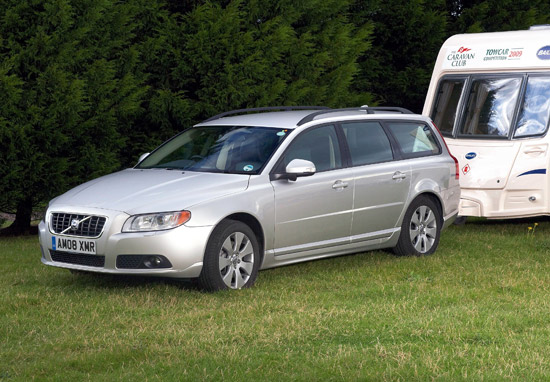
Meanwhile, the Advance Haldex All-Wheel Drive system with Instant Traction™ has an electronic management system that constantly monitors the speed of the wheels and throttle, engine torque and the brakes. As driving conditions change, wheels with the best grip get the most power.
Chris Wailes, product manager at Volvo Car UK Ltd, said: “We are delighted to win another Caravan Club Towcar of the Year award as they are a great recognition of Volvo’s commitment to developing good towcars and carry a great deal of respect from the public and our retailers.”
This award builds on Volvo’s previous success at the Caravan Club Towcar of the Year competitions, the 2007 Awards saw the Volvo V50 D5 Sport not only win the ‘£25,001 to £33,000’ price class but it was also named the overall winner of the competition. The previous year the 185 PS variant of the Volvo D5 turbodiesel engine powered the XC70 AWD and V70 AWD to victory in no less than three classes.
Volvo’s commitment to building great towcars is well known. It performs gruelling towing tests for all its new models both in Sweden and the desert heat of Arizona, USA, and even has its own fleet of trailers and caravans which are towed by vehicles steered using advanced robot technology to ensure consistent testing methodology. This testing also includes measuring the lateral acceleration of the trailer and the angle between the car and trailer at different speeds so that steering forces, chassis settings and engines are tuned to optimise their performance when towing.